
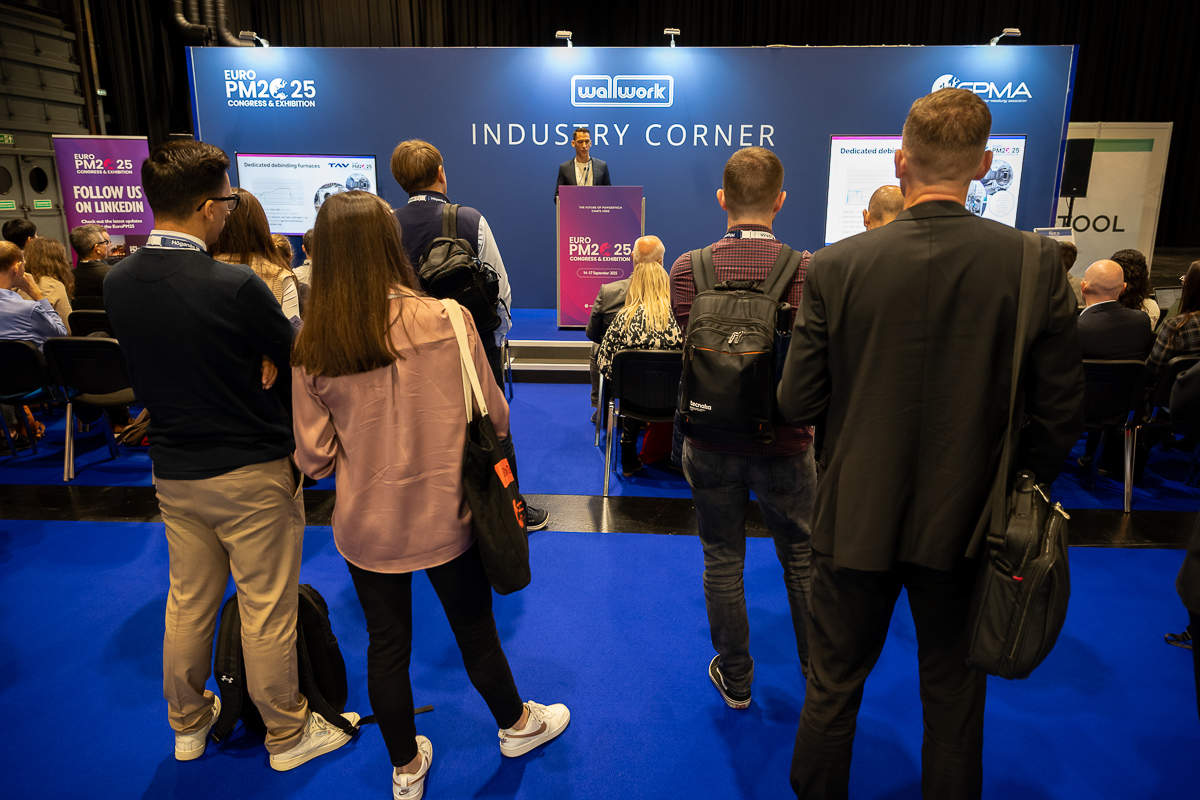
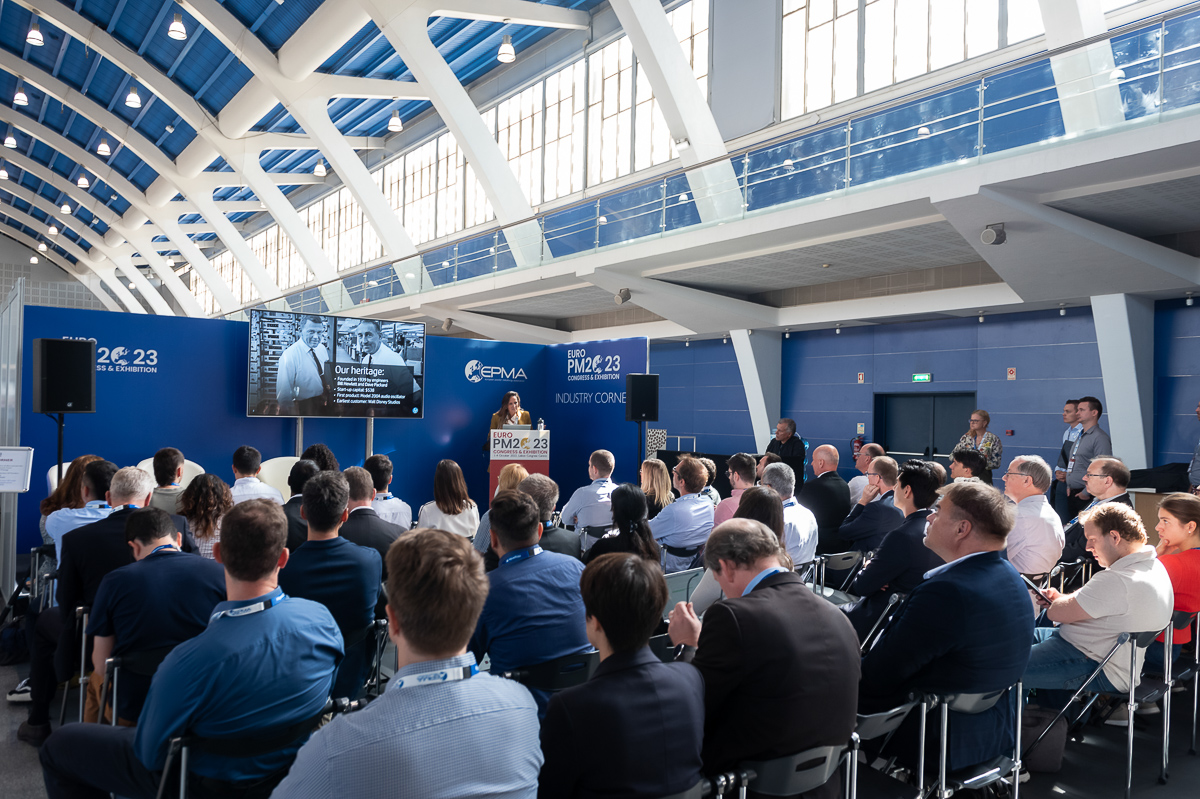
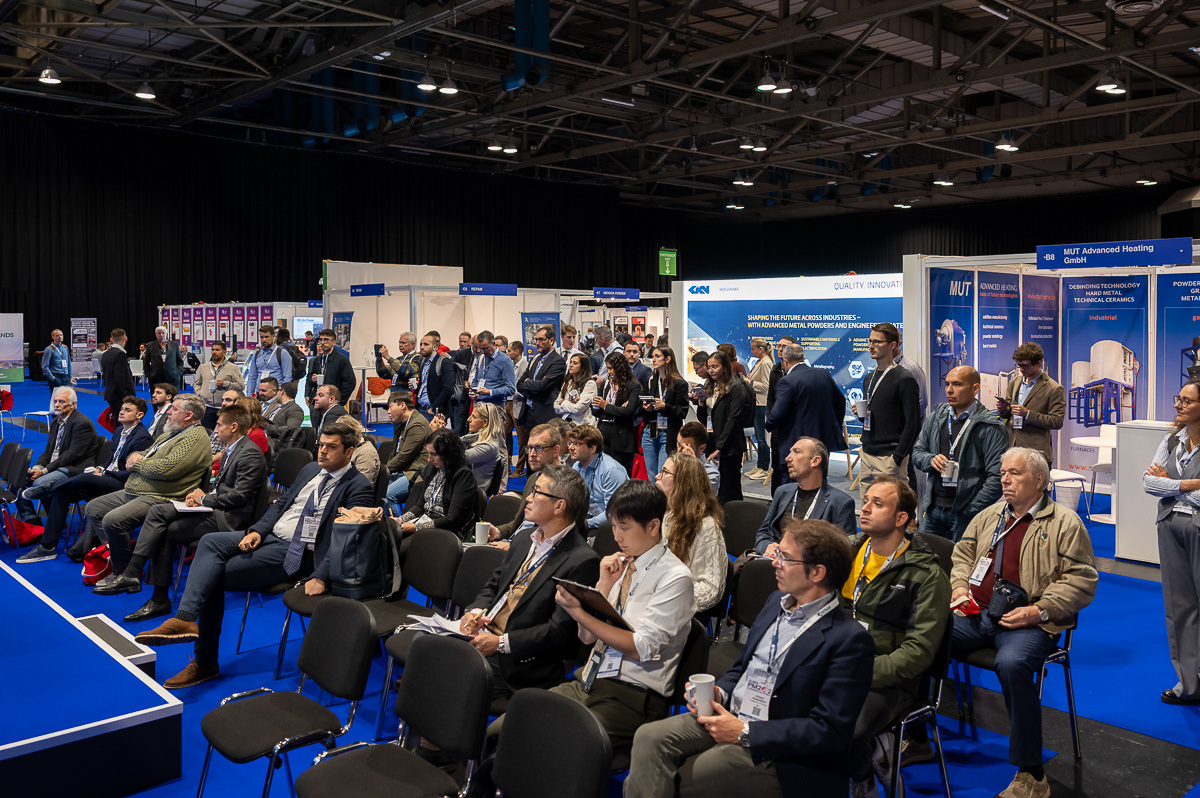
The Industry Corner presentations offers companies and industry experts the opportunity to share their latest developments, innovations, practical applications, and insights related to Powder Metallurgy technologies and engineering.
Each presentation consists of a 15-minute talk followed by a 5-minute Q&A session, providing an excellent platform for knowledge exchange, networking, and discussions between speakers and congress participants.
Monday 12 October
Time: 11:30 – 11:50
Ing.Pier Paolo Curti (RHP Technology)
Abstract:
Plasma Powder Deposition (PPD) is an atmospheric plasma-spray process suitable for coating temperature sensitive substrates such as polymers. This work shows that PPD can be used to deposit Mu-metal coatings on PEEK for low-frequency magnetic shielding, as an alternative to bulk Mu-metal parts. The coating reached a shielding factor of S ≈ 4 in the low-frequency plateau, around 60 % of the value measured on bulk Mu-metal under the same conditions. The result was obtained in the as-deposited state, without any post-deposition heat treatment, which is normally required for bulk Mu-metal to develop its full permeability.
Time: 13:10 – 13:30
Ing. Giorgio Valsecchi (TAV Vacuum Furnaces)
Abstract:
This presentation examines the main cost drivers associated with the sintering process in batch vacuum furnaces. Key variables such as furnace size and usable load, hot‑zone configuration, heating system layout, process gases, and overall cycle design will be analyzed to assess their impact on both CAPEX and OPEX.
The goal is to provide a structured methodology and practical tools for evaluating trade-offs between the different technical and economic factors that influence the total cost of ownership of a sintering line. Several case studies will be presented to illustrate how different design choices and process parameters affect productivity, unit cost, and return on investment, helping users identify the most cost-effective furnace configuration for their specific production needs.
Tuesday 13 October
Time: 09:55 – 10:15
Ing. Martin Walcher (st screening technologies GmbH)
Abstract:
The company st screening technologies GmbH specializes in screening technology with a strong focus on fine and ultrafine classification . As the general importer and European representative for ELCAN Industries, we aim to introduce the advantages of high-energy screening, which has proven highly successful in processing metal powders, to a wider audience.
The demands placed on raw materials by new technologies in powder metallurgy, such as additive manufacturing, and especially LPBF, are manifold and challenging. Besides the high process-related costs in raw powder production due to expensive atomization (i.e., atomizing the melt with inert gas), low target particle yields at the specified, extremely tight product specifications (e.g., a particle size range of 15-45 µm) result from inefficient processes such as air classification, leading to very high production costs for the metal powders.
By using the “Hi- Sifter ” high-energy screening machine, which allows for fine particle sizes down to 10 µm in dry screening, it is possible to achieve a significant improvement in target particle yields while simultaneously drastically reducing energy and capital input. In addition to increased market opportunities for manufacturers, this significantly improves not only profitability but also sustainability in production.
From a historical perspective, the technology is based on an invention by Kroosh Technologies in the 1990s. The principle is to maintain a system in the resonant range, thereby making many times more energy available to the actual process than in a “normal” vibration system operating in the “post-resonance range.” The enormous acceleration forces achievable in this way on the loose working screen (patented technology) result in extremely rapid layer formation and enable very high throughput rates and very fine separations without the risk of the screen mesh becoming clogged. This makes the system ideal for difficult and “impossible” screening tasks.
ELCAN Industries has been involved in high-energy screening technology since its inception and has gained extensive experience in processing a wide variety of materials through its own contract manufacturing facilities in the USA. The “Hi- Sifter ,” developed in collaboration with a partner company in Japan, represents the state of the art in this field and is now being used very successfully in many industries.
Since June 2025, st screening technologies and ELCAN Industries have been offering the opportunity for screening tests with the Hi-Sifter to interested companies in the brand-new test center in Austria.
Time: 10:20 – 10:40
Dr. Santiago Cano (Incus GmbH)
Abstract:
Metallic components with small and intricate features, low surface roughness and high densification and quality can be produced by the Lithography-based Metal Manufacturing (LMM). As a sinter-based additive manufacturing technology, the process employs organic binders highly filled with metal particles, that are selectively photopolymerized by the action of light. Following shaping, the green parts are cleaned and finally debound and sintered to obtain dense metallic components.
With a customer-oriented approach, the base materials and processes for LMM have been developed through the years at Incus GmbH, opening applications in the medical, dental, electronic and jewellery sectors among others. This presentation will show how the intrinsic advantages of LMM are leveraged in exemplary case-studies by enabling and perfectioning novel designs and direct transitioning from prototyping to production scale.
Time: 12:45 – 13:05
Dr Paul Davies (Wall Colmonoy Limited)
Abstract:
The imminent Euro 7 regulations on non-exhaust vehicle emissions, particularly brake dust, are reviewed in relation to advanced metal powder surface coating technologies for automotive brake rotors. The presentation highlights how processes such as Cold Spray, and Extreme High-speed Laser Deposition (EHLA) can significantly reduce particulate emissions, improve durability, and are scalable for mass production. The presentation details the technical and economic considerations of coating grey cast iron rotors with stainless steel and carbide powders, noting that these solutions are being widely adopted by vehicle manufacturers to meet new emission limits. Ultimately, metal powder-based coatings are presented as a practical, cost-effective path for the automotive industry, for both passenger vehicles, as well as Commercial & Heavy Goods Vehicles, trains & metros, to achieve Euro 7 compliance and improve urban air quality.
Time: 13:15 – 13:35
Ms. Kei Takenuma (Epson Atmix)
Abstract:
・While gas atomized powders have been commonly used in metal 3DP, recent years have seen increased attention on water atomized powders due to the diversification of supply chains and material options.
・Epson Atmix’s water atomized powders are used in sintering applications such as MIM.
・ While typical water atomized powders have irregular shapes, we are able to manufacture spherical powders. Furthermore, surface treatment of the spherical powder improves its fluidity.
・ This allows for its use in 3DP manufacturing methods (BJ, laser). For BJ, excellent material properties (density, shrinkage rate) have been achieved.
Time: 15:30 – 15:50
Dr. Amir Shirzadi (Cambridge Joining Technology / The Open University)
Abstract:
The patent-pending invention enables solid-state bonding of additively-manufactured structural components with complex shapes, non-planar surfaces, hollow structures and multiple joints in any directions. The bonding is carried out in a Hot Isostatic Pressing (HIP) furnace without any encapsulation.
This novel technology offers significant advantages in additive manufacturing and restoration of high-valued components e.g. turbine blades made of nickel-based superalloys or high-speed tool steels. Monolithic joints comparable in strength to the parent materials have been achieved in titanium, stainless steel and nickel-based superalloys.
(International Patent Application: PCT/GB2025/051044 )
Wednesday 14 October
Time: 09:55 – 10:15
Roozbeh Valadian (Granutools)
Abstract:
A proper characterization of the feedstock is essential for powder bed-based AM processes. Indeed, slight variations in the material properties can induce a degradation of the layers quality which will impact the part quality. However, the current standards commonly used in powder metallurgy are based on outdated methods that do not provide sufficiently relevant information and/or accuracy to accommodate the increasing needs of the processes. Fortunately, a lot of efforts have been made during the last decade to develop new characterization methodologies that provide deeper insights into powder behavior. For example, the Cohesive Index metric of the Granudrum instrument (Granutools, Belgium) has been proven to be a good metric for spreadability prediction, leading to a recent ISO/ASTM standard [ISO/ASTM TR 52952:2023]. The well-known tapped density analysis has also been significantly improved recently [Lumay et al., Powder Technol. 2012]. Despite these methods are now widely used in the industry, the development of updated standards is still lacking. In this presentation, the audience will be introduced to state-of-the-art powder characterization methods and especially the usefulness of the information they can provide. The necessity of developing new standards to catch up with the fast-moving AM industry will be highlighted.
Time: 12:45 – 13:05
Mr Alex Yu (Avimetal AM Tech Co., Ltd.)
Abstract:
This presentation introduces AVIMETAL’s full portfolio of high-performance metal powders, produced via advanced gas atomization technologies. We showcase key product series including titanium alloys, nickel-based superalloys, aluminum alloys, pure copper, and specialty materials, covering detailed powder characteristics, mechanical properties, and industrial use cases across aerospace, medical, consumer electronics, and automotive sectors. The discussion also highlights our quality control standards, batch consistency capabilities, and tailored powder solutions for different consolidation processes.
Time: 13:15 – 13:35
Mr Stuart Jackman (SERIC)
Abstract:
The presentation will introduce ultrasonic treatment of semi solid manufacturing technology in achieving tailored structures; namely improved grain size control, finer grained materials and therefore enhanced mechanical properties are anticipated including specific strength & stiffness. Related joining technologies will also be covered as part of this talk, and candidate processes will be introduced. The technology will be discussed in light of its capability for producing near net shape components from initially light alloy systems e.g. Aluminium as well as others such as Mg or Ti. Inherent ability to control microstructure with the proposed technology will enable porous materials as well as functionally graded systems. The proposed technique can utilise powder feedstock in the form of pressed parts of a chosen geometry and size. It can also use pellets/ingots. Relevant applications in the context of the potential of the technology with example industry sectors will be considered for powder metallurgy.