
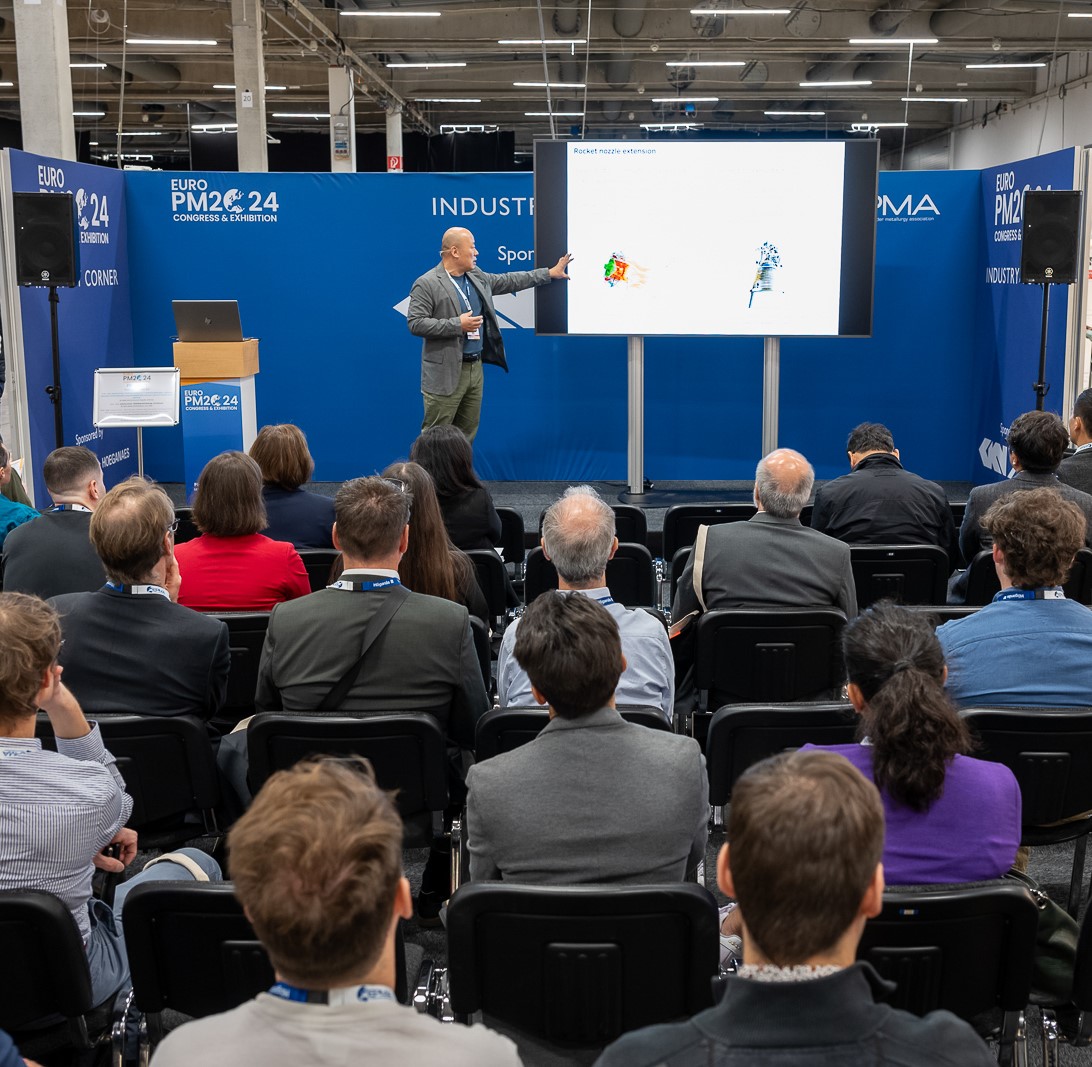
Technical Briefs offer a dynamic presentation format designed to encourage rapid knowledge exchange within the Powder Metallurgy (PM) community.
These short presentations provide an opportunity to share preliminary results, innovative ideas, ongoing research, industrial achievements, process developments, technical analyses, and case studies in a concise and interactive format.
Technical Briefs are not included in the Congress Proceedings, giving authors the flexibility to further develop and publish their work through other channels.
Each Technical Brief lasts 10 minutes, including discussion, allowing participants to present their work and engage with the audience in a focused session.
Programme
Mrs Beyza Bilgiler, Sentes-BIR, Türkiye
Abstract:
Inconel 718 powders for Powder Bed Fusion – Laser Beam (PBF-LB) are commonly produced by argon gas atomization; however, nitrogen atomization offers potential economic and metallurgical advantages. In this study, nitrogen- and argon-atomized Inconel 718 powders were comparatively evaluated in terms of chemical composition, particle size distribution, microstructure, oxygen and nitrogen contents, and mechanical properties after PBF-LB processing. The nitrogen-atomized powder exhibited a higher nitrogen content (0.046 wt.%) and lower oxygen content (0.013 wt.%) than the argon-atomized powder (0.007 wt.% N and 0.023 wt.% O). Both powders showed comparable particle size distributions and suitable characteristics for PBF-LB processing. Tensile testing revealed that specimens produced from nitrogen-atomized powder achieved slightly higher yield strength and comparable ultimate tensile strength in both as-built and heat-treated conditions. The results indicate that nitrogen atomization can provide a cost-effective alternative to argon atomization while maintaining powder quality and mechanical performance required for PBF-LB applications.
Dr Adam Hunt, Globus Metal Powders, UK
Abstract:
Powder metallurgy hot isostatic pressing (PM-HIP) offers many advantages for alloy processing, including near-net-shape manufacturing, reduced material waste, and the ability to produce fully dense components with uniform microstructures. However, extending PM-HIP to new alloy systems, particularly precipitation-strengthened alloys, has proven challenging. The formation of prior particle boundary (PPB) networks during consolidation can act as sites for crack initiation, limiting mechanical performance. In precipitation-hardened systems, these boundaries can also promote the preferential formation of deleterious phases, inhibiting optimal precipitation behaviour and reducing achievable strength, ductility and toughness.
Globus Metal Powders have explored strategies to overcome these limitations through the development of improved powder chemistries and surface conditions, alongside optimisation of HIP parameters and subsequent heat treatments. By addressing PPB-related defects and controlling phase evolution, the full mechanical potential of PM-HIP processed advanced alloys can be realised, with examples of nickel aluminium bronze and 718 nickel superalloy developed for PM-HIP.
Dr Maja Lehmann, Fraunhofer IGCV, Germany
Abstract:
Solenoid valve anchor housings require precisely defined ferromagnetic and non-ferromagnetic regions to ensure reliable switching states and accurate piston position control. In conventional manufacturing, achieving such spatially defined material distributions is challenging and involves multiple complex process steps. Multi-material (MM) Powder Bed Fusion of Metals using a Laser Beam (PBF-LB/M) offers a compelling solution, enabling three-dimensional material distribution within a single manufacturing step.
Fraunhofer IGCV investigated the combination of non-ferromagnetic and ferromagnetic stainless steel to produce a functional solenoid valve anchor housing. Specimens achieved relative densities above 99.9%, with minimal defects in the material transition zones.
To investigate the magnetic properties of the materials manufactured via MM PBF-LB/M and to compare them to conventionally manufactured materials, test specimens were produced and analyzed in various heat treatment states. The findings demonstrate the strong potential of MM PBF-LB/M for producing high-performance solenoid valve components.
PhD Vinicius Henriques, CTA, Brazil
Abstract:
The characteristics of Ti alloys make them an attractive choice for advanced engineering applications in demanding conditions. Titanium alloys have high strength-to-weight ratios, deep hardenability and high biocompatibility exhibiting high potential for use in niche applications for aircraft structures, orthopedic implants, and orthodontic devices. The difficulty of producing complex shapes of these alloys by conventional methods for reasonable costs makes Metal Injection Moulding (MIM) attractive. Sintering behavior, microstructure and mechanical properties of a Ti–35Nb alloy processed by MIM technology from hydrided powders were investigated in this work by X-ray diffraction (XRD), scanning electron microscopy (SEM), energy dispersive spectroscopy (EDS), and thermal and microhardness analysis. Samples with relative density up to 98% have been produced using a feedstock based on wax-polymer binder. The microstructural evolution observed during sintering from 900 °C up to 1500 °C indicates a combination of densification and optimized microstructure reached because of the complete dissolution of the β stabilizers in the titanium matrix. The injection and sintering parameters provided a homogeneous microstructure with high densification. Higher sintering temperatures or longer holding times can lead to intensive grain growth.
Mr Harry Heptinstall, Imperial College London, UK
Abstract:
WC-Co hardmetals remain the material of choice for turning and milling operations where tool-tip temperatures exceed 1000°C, yet their high-temperature deformation mechanisms are poorly understood. Here, two dopant compositions – WC-9.65wt%Co-1.26wt%Cr and WC-9.65wt%Co-1.26wt%Cr(+Ti,V) – were deformed by four-point-bending at 1100°C, and large-area EBSD maps were acquired across the resulting strain gradient. Increases of Σ2 boundary fractions and {10-10} plane prevalence demonstrate that deformation drives WC/WC boundaries toward lower-energy configurations.
Our high-resolution STEM-EDS shows segregation on stepped grain boundary facets and nanoscale CrC precipitation at WC/Co interfaces. Previous studies link this behaviour to suppressed grain growth. We observe that the segregation also inhibits the evolution of the GBCD during deformation.
These nanoscale dopant-boundary interactions are reflected in grain boundary plane distributions. This establishes that GBPDs facilitate understanding of microstructure dynamics from accessible EBSD analysis without the requirement for TEM. This opens GBPD analysis as a characterisation tool for microstructural hardmetal optimisation